



Table of Contents
- What Exactly Is GEO (Generative Engine Optimization)?
- Does Generative Engine Optimization Service Matter?
- How Does GEO Work?
- Is GEO A Ranking System?
- How to Conduct a GEO Audit
- GEO vs. SEO: What Is the Difference?
- Does GEO Mean No More SEO?
This is probably the first time you’re hearing about GEO, or not. It’s called Generative Engine Optimization, and we’ll be breaking down everything you need to know about this recent AI practice.
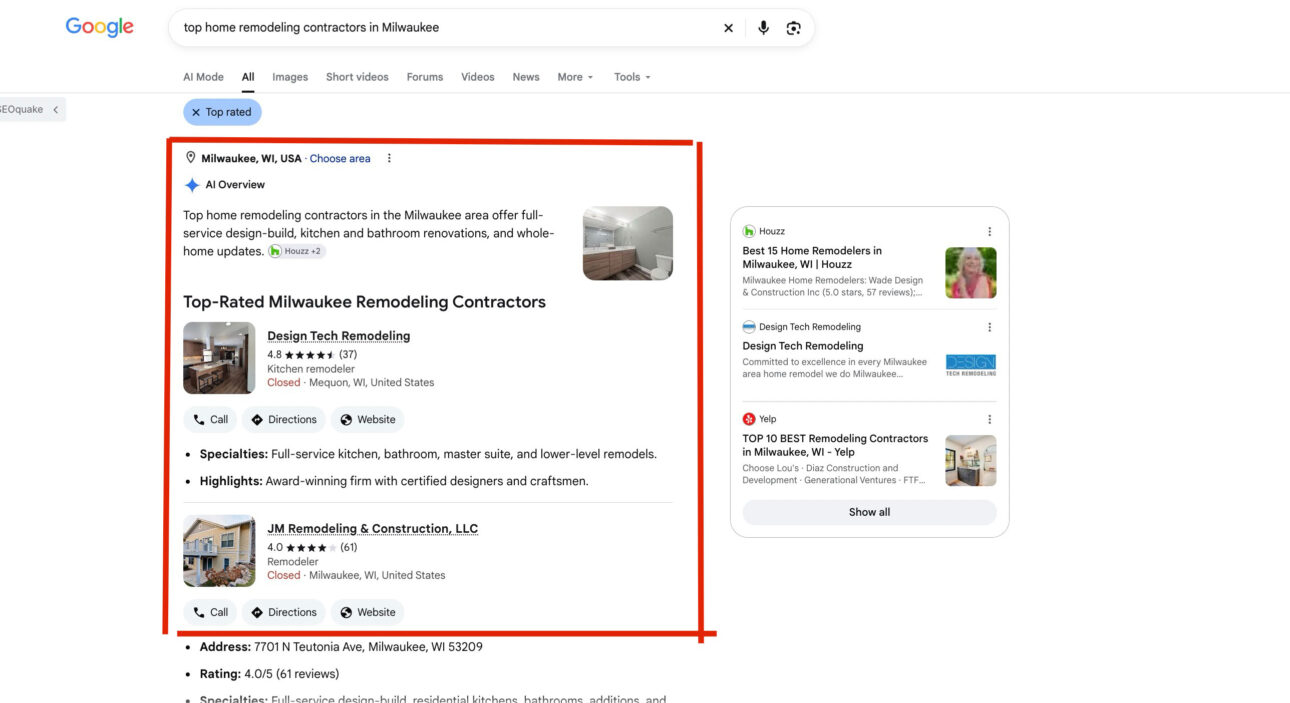
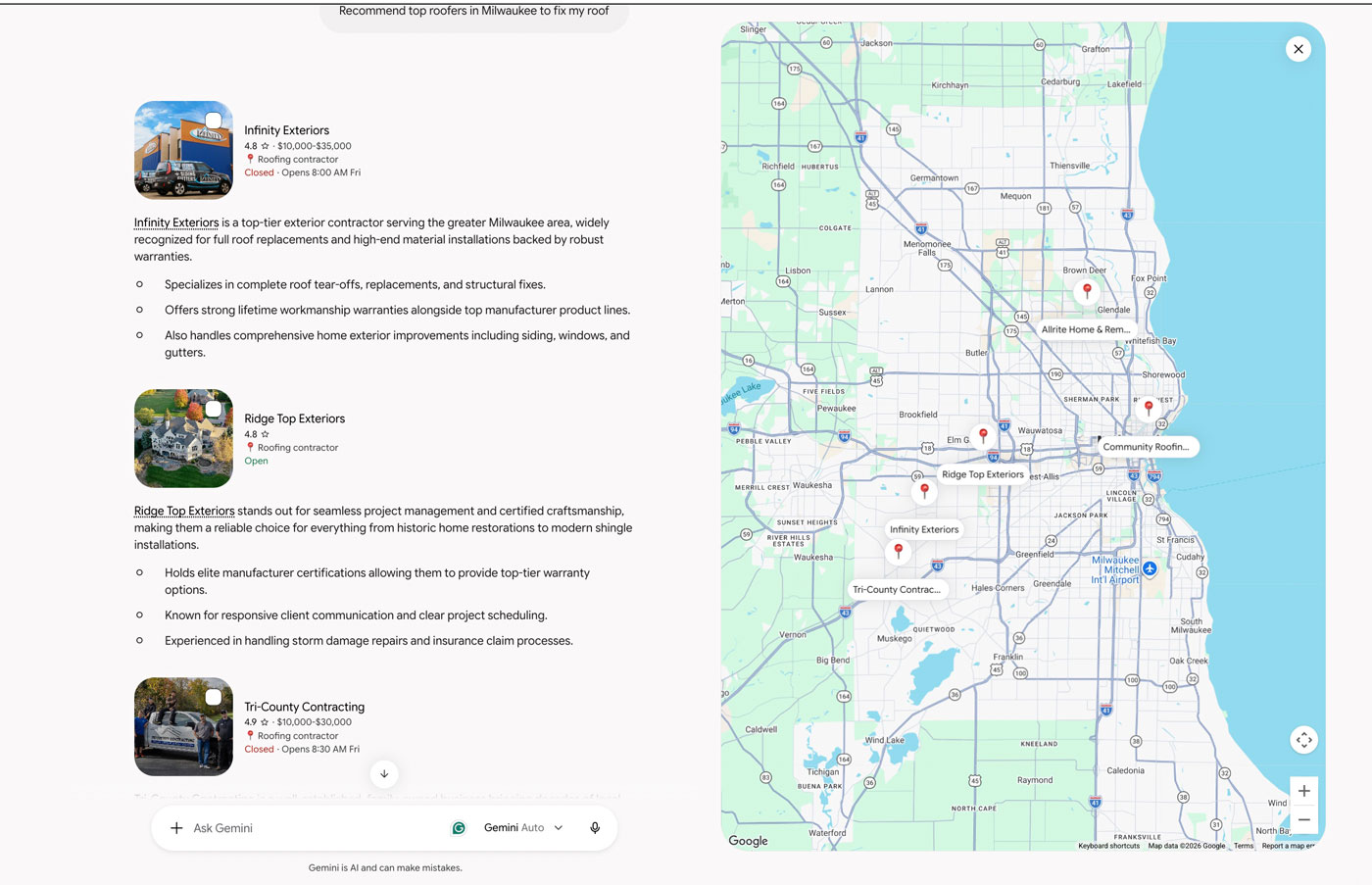
You’re somewhere in Milwaukee looking for ‘the best roofing contractors’ near you. You hit Google and enter those words. But instead of multiple blue links with several meta titles, you find a detailed AI summary at the top.
That’s exactly what GEO is about.
According to a 2026 survey, 45% of people now use AI for local business recommendations. Several businesses now get leads directly from ChatGPT or Gemini.
But the challenge? AI doesn’t list every single roofing contractor on the web.
You may have a great website and a steady stream of customer reviews. But when someone scrolls through random AI recommendations, you’re nowhere to be found.
What to do? That’s what you’re about to find out.
First, let’s discuss Generative Engine Optimization in detail.
What Is GEO (Generative Engine Optimization) in Marketing?
Generative Engine Optimization, or GEO for short, is a strategy to help your business appear in AI-powered searches. With GEO, potential customers are more likely to find you in AI-generated responses.
Before now, traditional Google searches were the norm. You entered a keyword on Google and got several related responses in form of a map pack and a list of links with small descriptions.
For business owners, the goal was to appear on the first page of results. You achieved this with SEO (Search Engine Optimization), which usually involves everything from keyword research to on-page SEO to performance tracking.
But today, AI has switched things up a bit.
Generative search gathers information from several sources and presents a detailed summary at the top of the search results. The chances of anyone clicking those blue links on Google’s SERPs are now lower than ever.
Does Generative Engine Optimization Matter?
Yes, it does. According to Google, its AI overview has 1.5 billion monthly users. Further research shows that shoppers often turn to Google Gemini and ChatGPT for product research, even though they end up verifying the recommendations from other sources.
Basically, GEO matters. It improves your chances of being discovered. For example, if you type “concrete contractor in New Berlin” into Google, you might see a brief AI summary of business recommendations and then a map pack underneath.
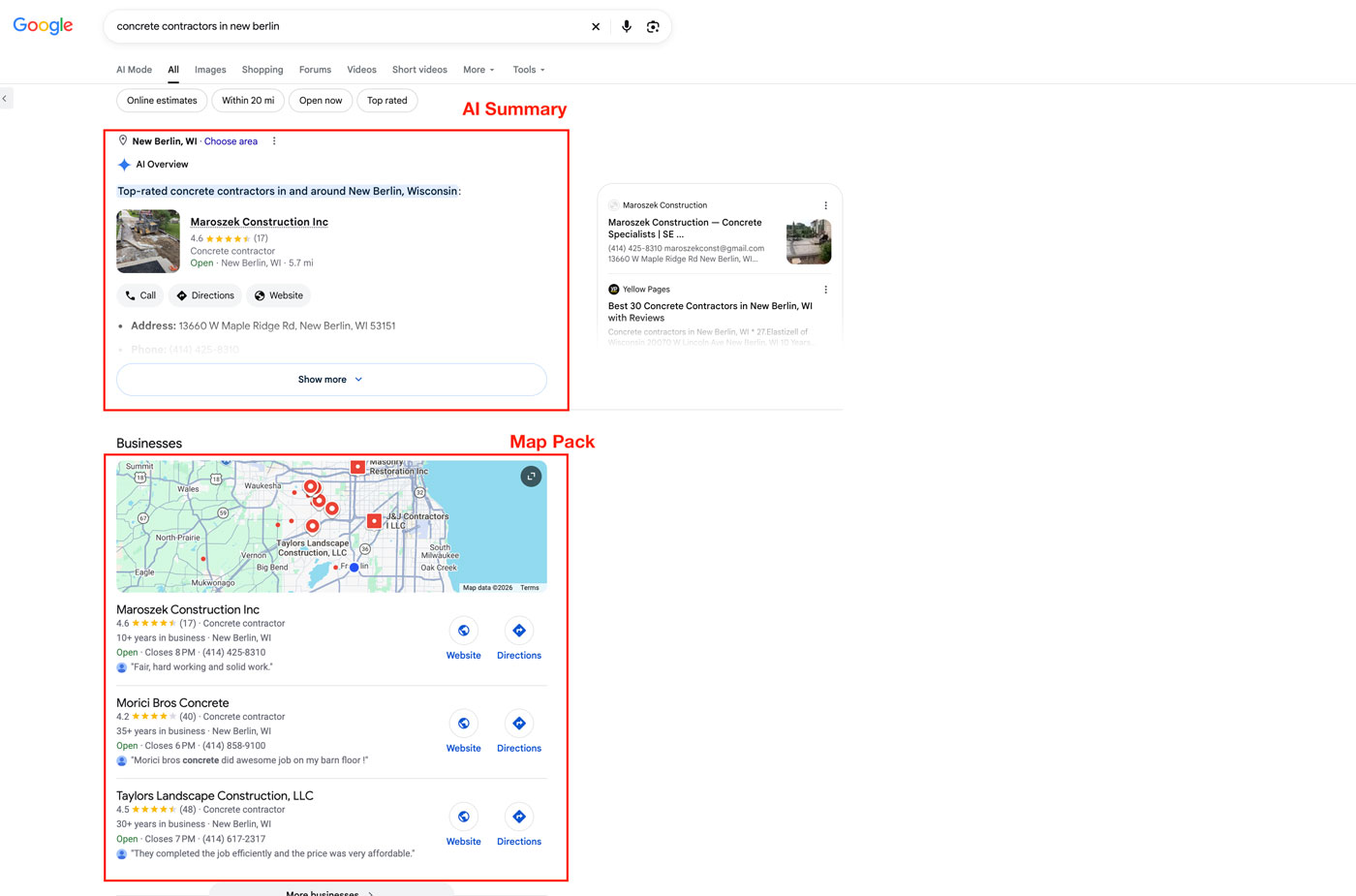
That means, for many buyers looking for local contractors, the AI summary is the first thing they’ll see. While many local searches like this still prioritize map packs, up to 68% of local business queries return an AI overview.
So, How Does GEO Work?
The best way to understand how it works is to look at what happens between a customer asking a question and an AI tool producing an answer. Since there are several AI tools, the exact process will vary from platform to platform. Regardless, a typical AI search experience involves the following steps:
The system retrieves relevant information
Some AI platforms search the web or gather information from an existing search index. Others may combine web results with information available through other connected sources.
Let’s look at where each top AI platform gets information from:
ChatGPT
ChatGPT gets its results from different sources.
For fixed, static requests, it retrieves information from its training data, which was cut off in 2025 for older models and early 2026 for recent ones. An example of such a fixed query is: “What is the capital of Australia?”
For other searches that require live updates or recent information, ChatGPT runs a live web search. It relies on third-party search providers like Bing and its own crawler, OAISearchBot, to surface websites.
Does ChatGPT get most of its information from a specific third-party search engine? That’s a tricky question. Seer Interactive’s research based on 100 queries found that ChatGPT got most of its answers from Bing. Most of the citations appeared in Bing’s top 20 results.
Ahrefs later tested the theory with 15,000 long-tail queries and found that only 8.1% of the cited links appeared in Bing’s top 10 results. It’s unclear where the other results came from.
But ChatGPT may have used a process called query fan-out, meaning it searched different variations of each query to get its result.
The content licensing deal ChatGPT struck with Yelp grants it access to Yelp’s database of about 8 million business listings. So, ChatGPT relies heavily on this database for local-intent queries.
No conclusive research exists on the exact third-party platform ChatGPT uses. But one thing is clear: you need to list your local business on Yelp to appear in ChatGPT citations.
You also want to deliver structured content that ranks well on Bing.
Gemini
Gemini’s search pattern evolves from Google’s web index. When you search for information, Gemini uses search grounding to retrieve local answers from Google’s live search index.
It sources data from high-authority websites indexed on Google, forums like Reddit, and YouTube.
For geo-specific questions, Gemini gets data from the Google Maps database. Hard facts like the year a company was founded come from Google’s knowledge graph.
Perplexity
This AI tool runs its own search index. Perplexity recommends allowing its crawler, PerplexityBot, access to your robots.txt file to improve your chances of being cited.
Like ChatGPT, the company also integrated the Yelp database for more localized recommendations.
Can you get cited on most AI tools? Yes.
Across sources, generative search engines rely on consistent trust signals, such as a clear entity identity and content richness.
So, as long as your business has a clear identity across the web and your content is richly detailed, then your chances of getting cited are higher.
Your website also needs to be accessible and eligible for the relevant search before it can be used as a source. This is what local SEO does for local businesses, and why it remains important.
The system evaluates information for relevance.
The AI platform evaluates the available information to determine what best meets the user’s needs.
A page about residential roof replacement in Milwaukee is more relevant to a Milwaukee homeowner looking for roof replacement than a random article about commercial roofing in another state.
Relevance here also involves context. Someone looking for an emergency plumber has different needs than someone comparing the cost of replacing plumbing throughout an entire house.
That is why your website’s content should clearly explain what you offer, who you serve, and which problems you solve. Your local citations, one of the top SEO ranking factors, are also key in this context. Accurate and detailed listings are a great source of information for AI platforms.
The AI generates a response.
Next, the system combines information from all available (and, of course, relevant) sources and provides a straightforward answer.
The kind of answer it provides depends on the type and intent of your query. For informational queries (queries that need an answer to a question), it provides a detailed explanation and in some cases, cites where it got the information from.
For commercial queries (queries that intend to purchase or inquire about services/products), it’ll provide recommendations and summarize the details of the businesses it recommends.
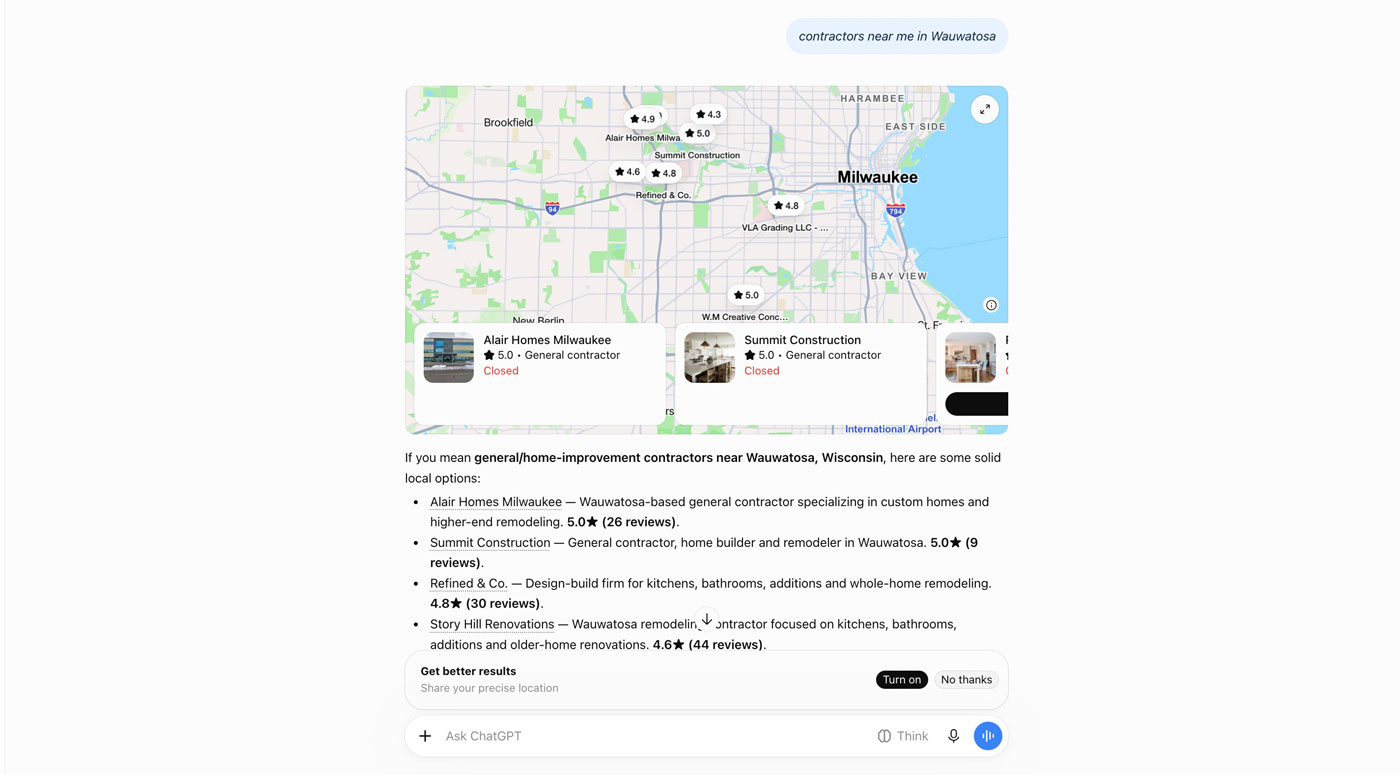
But keep in mind that being used as a source doesn’t mean you’re also recommended as a business. Your blog post may be cited to explain how roof replacement works, but your business may not be recommended for the job.
The customer decides what to do next.
The customer decides what to do next. Some customers review the cited sources and click the link that takes them directly to your website. From there, they may call your business or request a quote straight up. Others may skip the response and keep researching.
Research shows that 89.9% of US shoppers who used AI for product recommendations still verified a third-party source before buying.
This is the point where GEO connects with the rest of your marketing strategy.
Is GEO A Ranking System?
GEO is not an actual ranking system for AI platforms. It’s a marketing and visibility strategy. The endgame is to have a specific brand AI models recognize and acknowledge.
When citing websites, AI systems often focus on:
- Credibility and third-party validation
- Semantic clarity
- Content structure like statistics and specific answers to core questions
However, AI tools (ChatGPT, Microsoft Copilot, Google’s AI search summary, and so on) do not necessarily present results the same way. They pull information from different data ecosystems.
In essence, there is no general GEO ranking position as you’d normally find in SEO website rankings. A business may be mentioned in one AI result, left out in another, and cited as a source in a third.
How to Conduct a GEO Audit
Do the following to check your visibility across AI platforms:
- Enter real customer questions on each platform and see if your business comes up.
Tip: Phrase those questions the way a buyer or client would. Use the “People also asked section” on Google search for inspiration if you need one.
- Track how well AI platforms cite your website.
- Use the AI performance report in generative optimization tools like Bing Webmaster Tools. In Bing Webmaster, open AI performance to see AI summaries in Bing. Check for these metrics:
- Total citations: This is how often your content was shown as a source in AI answers.
- Average cited pages: The average number of unique pages from your site cited per day.
- Page-level citation activity: How often each page gets cited.
- Grounding queries: The key phrases AI used to retrieve your content.
- Check the generative AI performance report on Google Search Console to see the impressions your site has gained from AI platforms.
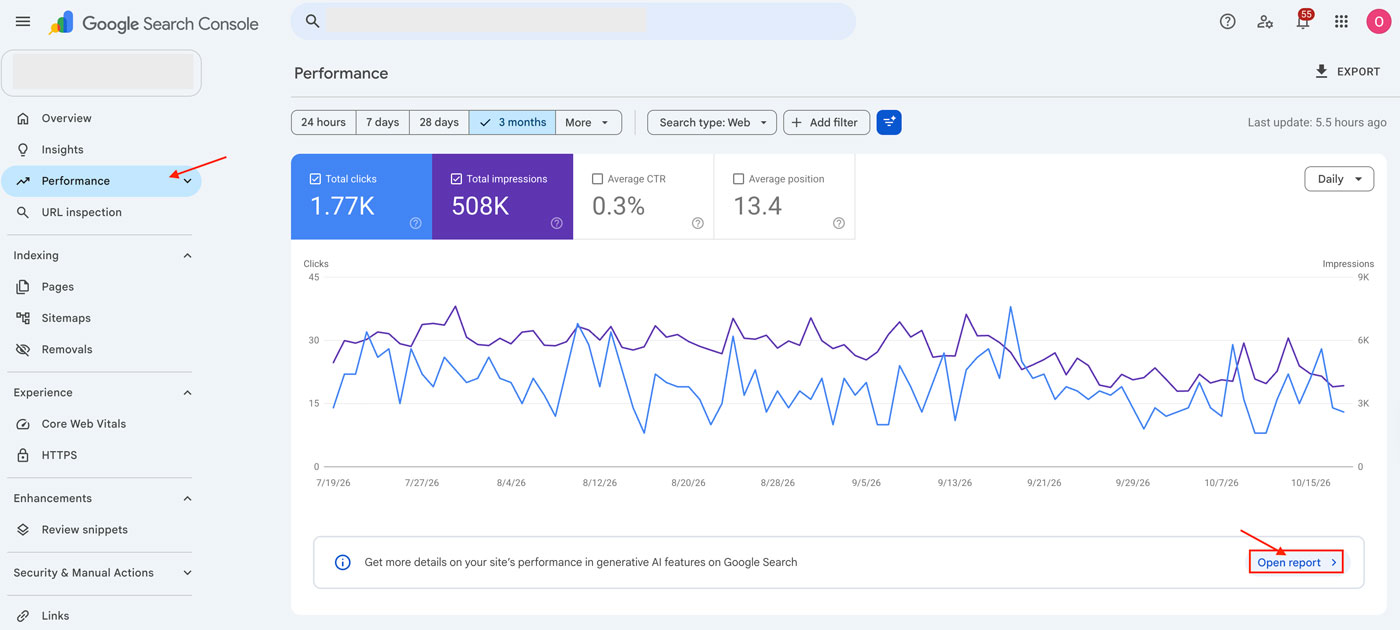
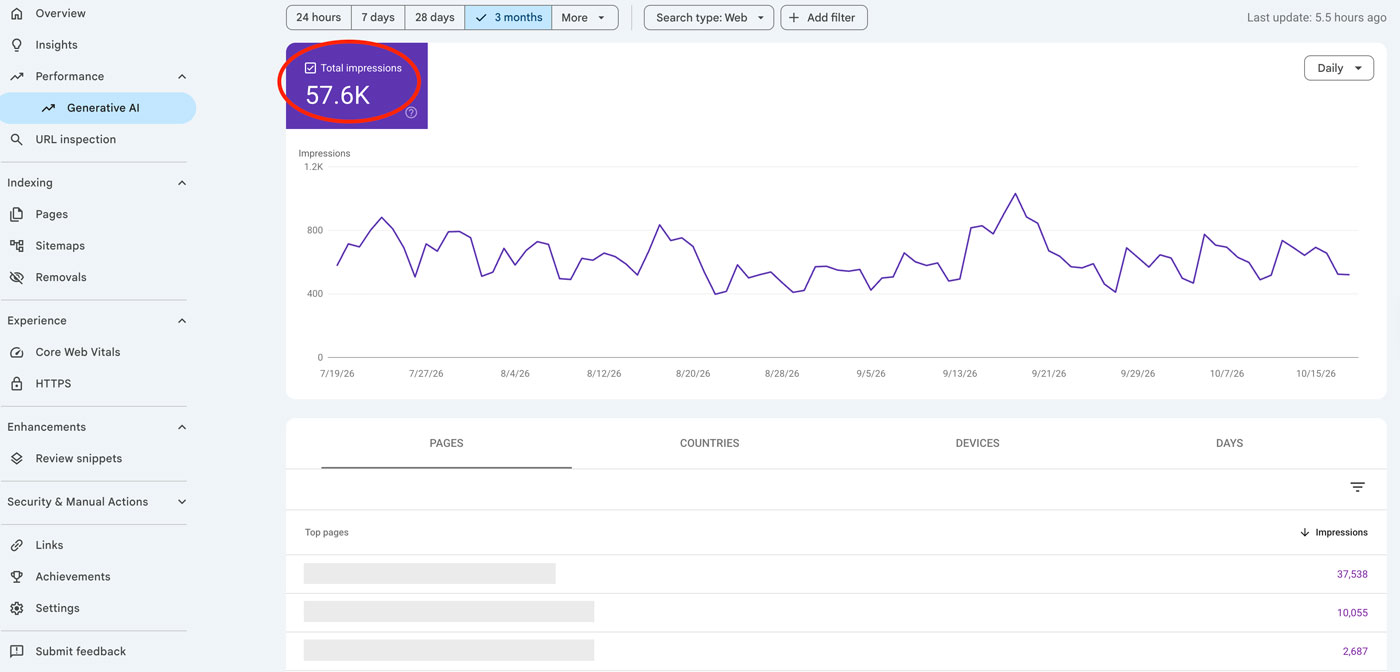
Tip: Does AI cite your website? Check what pages they link to under Top Pages.
- Use the AI performance report in generative optimization tools like Bing Webmaster Tools. In Bing Webmaster, open AI performance to see AI summaries in Bing. Check for these metrics:
Google Console shows one core metric: Impressions. That’s quite thin on details. For deeper insight, site owners combine it with tools with more metrics.
Third-party tools like SEMrush’s AI Visibility Toolkit report a visibility score, mentions, share of voice, and sentiment.
Ahrefs Brand Radar provides a list of mentions and citations. Local Falcon also tracks brand mentions and sentiment in AI answers.
No platform can provide perfect, precise data. So, the metrics should be treated as a rough guide.
GEO vs. SEO: What Is the Difference?
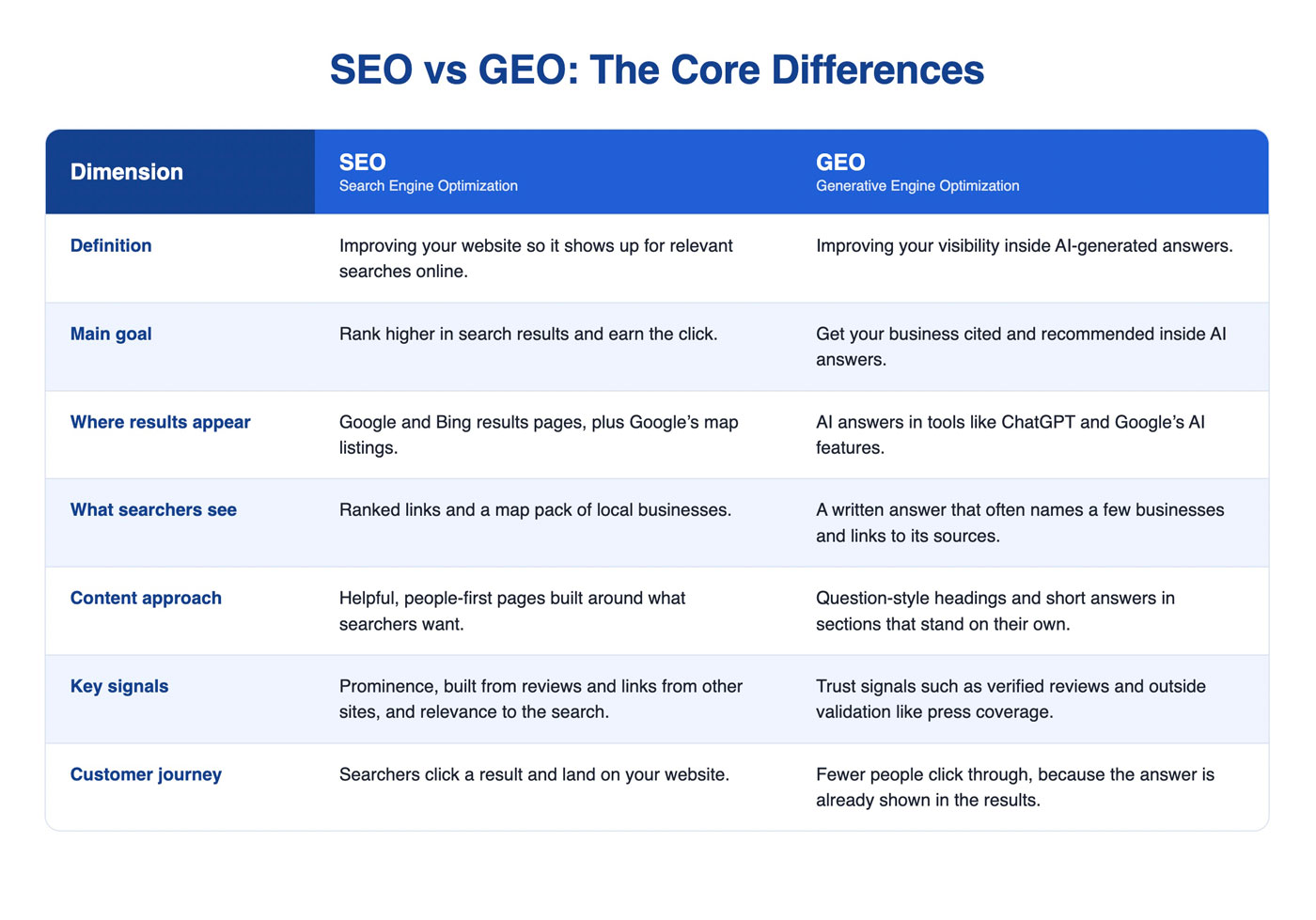
SEO (search engine optimization) is everything you do to improve your website so it shows up for relevant searches on search engines. This includes on-page SEO techniques like keyword research, off-page SEO techniques like link building, and technical SEO strategies like crawlability/indexing.
GEO, on the other hand, focuses on being visible within AI-generated responses. This includes, but is not limited to, providing well-structured content and having a clear business identity.
The differences may not be as clear as the similarities, and yes, there’s an overlap. Both work with credible online signals and useful content from accessible websites, but they’re not the same.
The main difference is the type of visibility you want to improve. In practice, an SEO strategy aims to rank your pages on SERPs, while GEO makes your website credible enough for AI tools to cite it.
How do you gain credibility on AI platforms? That’s where AI trust signals come in.
AI Trust Signals that Drive AI Recommendations
What are AI trust signals? And how do they affect your AI visibility as a local contractor?
AI trust signals are digital cues or structural markers that show generative search engines your website is credible and trustworthy.
The question is: how do you show ChatGPT or Claude that you are worth citing? Here are a few tips, classified into on-page (tactics you implement on your website) and off-page (tactics you implement off your website and on other websites or platforms).
On page GEO Tactics
- Allow crawlers: We already established that some platforms use crawlers to retrieve information online. So, it’s in your best interest to allow them access your robots.txt file. For Google’s AI features, make sure you run a detailed website audit to confirm that your page is indexed.
- Answer direct questions: Have clear, well-structured answers to user queries. Most importantly, make your business offerings easy to understand. Cover topics like repair costs, inspection costs, which materials suit which roofs, what a warranty covers, and other essential details.
- Keep business details uniform: For emphasis, maintain consistency across platforms and online directories.
- Content Structure: Generative search engines rely on a process called Retrieval-Augmented Generation (RAG), where they retrieve blocks of online text to answer questions. To help search engines find you, keep your content well-structured and easy to understand.
This typically involves following basic rules like:
- Using clear header tags for proper hierarchy.
- Writing clear, short paragraphs for easy retrieval.
- Remembering E-E-A-T is still as important as ever. AI platforms prioritize content with a verifiable author over random, anonymous content.
- Using author bios when possible
- Using proper schema markup for organization.
Off-Page GEO Tactics
- Keep your Yelp and Google Business Profile accurate. Also, ensure your information is accurate across all the top directories and business review platforms like Angi, BBB, and Houzz. Generative engines scrape these platforms for information.
- Ask your clients to leave reviews on these platforms as well, especially platforms like Yelp, whose databases AI tools rely on. Gemini and ChatGPT display ratings and sum up their recommendations based on reviews they pull from these directories.
If you’re already familiar with SEO services, then you might have noticed how its tactics overlap with GEO. The fun fact is that you don’t need two different marketing strategies. Google says its AI features run on the same SEO fundamentals, and GEO adds a few deliberate checks on top.
What About AEO?
AEO stands for Answer Engine Optimization. It’s the process of improving your content so AI platforms can extract information from your site and cite it as a source when providing direct answers.
It’s closely related to GEO, but they are not the same. In AEO, the goal is to be cited in a response to a specific informational query. AEO focuses on short technical extractions, like short, direct paragraphs that answer a question, or schema markup.
For instance, if you ask Google, “How much does a flatbed tow cost per mile in West Allis?” you’ll get a direct answer with a few cited sources, as shown below:
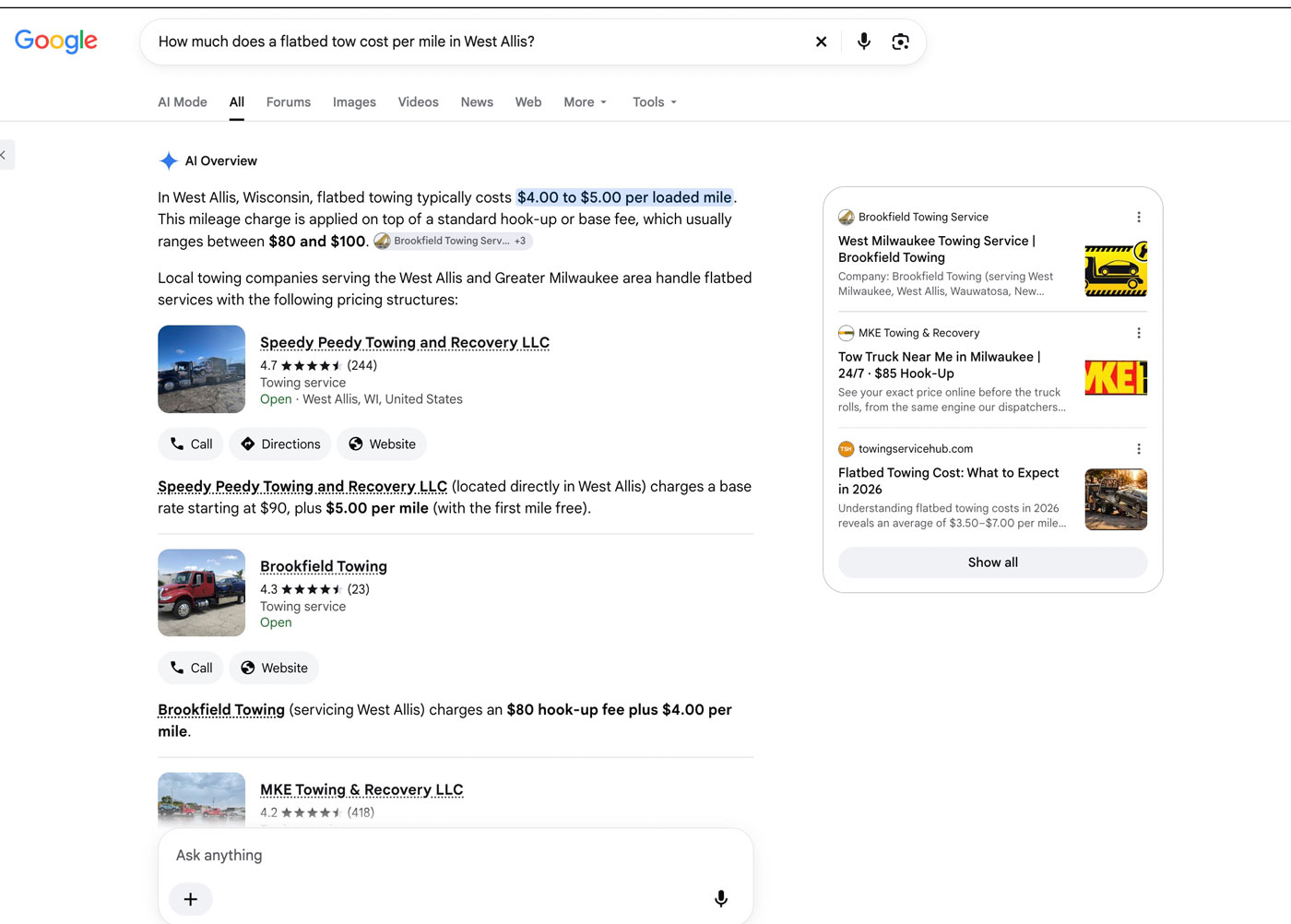
Optimizing your website content so that it’s included in responses like this is AEO. Sounds like GEO? Perhaps. But GEO is broader than AEO.
While AEO focuses on specific content or answers like the above, GEO focuses on optimizing your brand as a whole and positioning it for recommendations in AI responses.
Does GEO Mean No More SEO?
Absolutely not. We already talked a little bit about how they overlap, so no, GEO doesn’t mean ‘dump SEO.’
In fact, Google says SEO remains relevant to business owners today. For your website to be recommended in AI searches, it needs to meet Google Search’s technical requirements.
Google makes it clear that there’s no special requirement to get mentioned in AI overviews. But that doesn’t mean you automatically feature in AI searches just because you follow SEO best practices.
Your website still needs to be easy to navigate and clearly position your brand. Plus, your content must answer real customer questions. Business details should be accurate, and your pages should clearly describe what you’re offering.
If you’d rather have help, Local Web Concepts provides SEO and web design services to Wisconsin contractors.


